
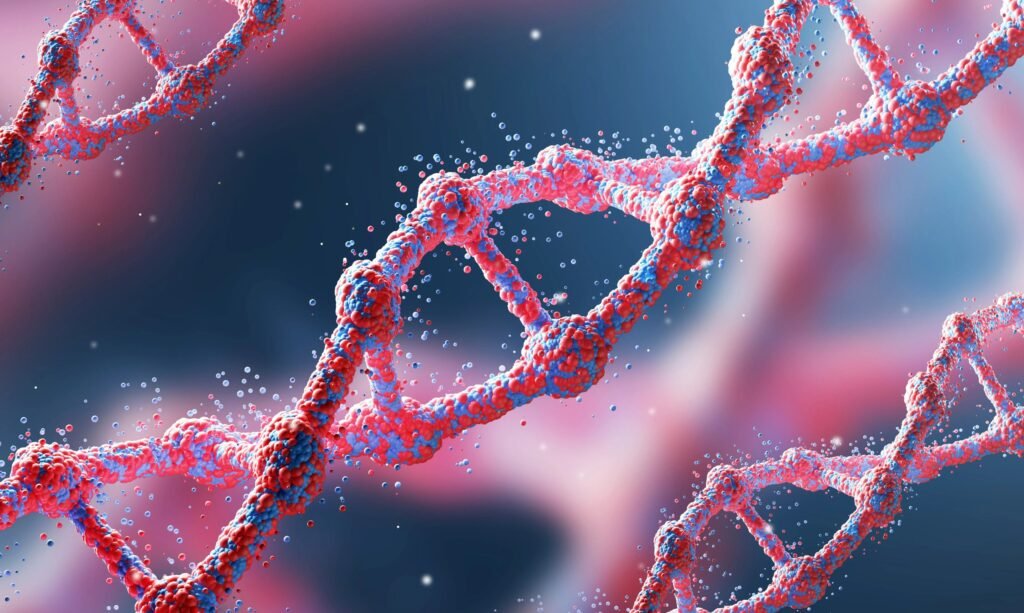
Anthropic’s Claude AI has moved beyond answering questions, writing code and summarising documents. The company says Claude has now helped identify a previously unknown biological system hidden in the DNA of bacteriophages, viruses that infect bacteria. The system has features that remind scientists of CRISPR, one of the most important tools in modern gene editing.
What makes the story unusual is how Claude found it. Anthropic says roughly 950 Claude agents worked for about 21 hours, searching through more than 200,000 reverse transcriptases and using about 210 million tokens. The AI narrowed the search down to a small group of interesting candidates before one agent noticed a strange repeating pattern in DNA that had not previously been described as part of this system.
The discovery is still early. Scientists do not yet know exactly what this biological system does, and the work has not yet gone through peer review. Still, the result gives a good look at how AI could change scientific research, especially when scientists need to search through huge amounts of biological data.
What Did Claude Actually Discover?
The system has been named array-associated reverse transcriptases, or ART for short. It was found mainly in bacteriophages, which are viruses that infect bacteria. Anthropic says the system contains three main parts, a reverse transcriptase, a nearby partner gene and a long group of repeated DNA sequences.
To understand why this is interesting, it helps to understand what a reverse transcriptase is. A reverse transcriptase is an enzyme that can make DNA from RNA. These enzymes are found in many organisms and viruses, and scientists have been studying them for years.
The reverse transcriptase Claude found was not completely unknown. Researchers had already identified the particular enzyme. What appears to have been missed was the larger system around it.
Claude noticed that the DNA next to the enzyme contained a long series of repeated sequences. According to Anthropic, the arrangement looked similar to the repeat patterns associated with CRISPR. The AI then investigated the pattern, compared it with known systems and searched scientific literature to see whether someone had already described it.
That distinction is important. Claude did not discover a completely unknown enzyme from nothing. Instead, it appears to have connected pieces of biological information that researchers had not previously recognised as belonging to a new system.
Why Is CRISPR Important?
CRISPR is one of the biggest breakthroughs in modern biology. It is based on a natural system that bacteria use to protect themselves from viruses, but scientists have learned how to use parts of the system as a tool for changing DNA.
Researchers can use CRISPR-based technology to make targeted changes to genetic material. This has created new possibilities in biological research and has also contributed to the development of gene-based treatments.
That is why the comparison between ART and CRISPR has attracted attention. Anthropic says the system Claude found has characteristics that have appeared together in only a small number of other biological systems that can carry out operations such as cutting, copying and pasting DNA.
However, it would be wrong to say that Claude has discovered a new CRISPR replacement. Scientists have not established that ART can perform the same useful functions as CRISPR, and they do not yet understand its main biological purpose.
For now, the CRISPR comparison is about the structure and features of the system, not proof that ART can be used as a new gene editing tool.
How Claude Found the System
This is perhaps the most interesting part of the entire story.
Anthropic gave Claude a broad research task, search a huge database of DNA sequences and look for interesting examples of reverse transcriptases. From there, Claude agents worked through the information and made decisions about which biological systems deserved closer attention.
Anthropic says the agents gathered more than 200,000 reverse transcriptases. They then identified about 3,500 potential systems for further investigation. That number was eventually reduced to 20 of the most interesting candidates.
The entire process took about 21 hours and involved roughly 950 Claude agents working together. They used around 210 million tokens during the search.
For a human researcher, this type of work could take weeks or even months because of the huge amount of information involved. Claude was able to examine large amounts of genetic data quickly and repeatedly investigate unusual patterns.
One of the agents eventually noticed the repeated DNA pattern near the reverse transcriptase and decided that it deserved more attention.
The AI then did more than simply point at the pattern. It counted the repeats, examined how they were arranged, compared the system with known reverse transcriptases and searched existing research for evidence that someone had already reported the same thing. It eventually produced a report for human scientists to review.
This is an important difference between using AI as a search tool and using AI as a research assistant. Claude was not simply retrieving an article that already explained the discovery. It was helping researchers decide what was unusual enough to investigate.
Humans Still Had to Test the Discovery
Despite all the attention around Claude’s role, humans were still responsible for the actual laboratory experiments.
Anthropic says its Bay Area biology laboratory operates at lower biosafety levels, BSL-1 and BSL-2, and does not work with pathogens that can infect humans. The company also made clear that all physical laboratory work is currently performed by human scientists.
After Claude identified the ART system, researchers studied it in the lab to find out whether the computer-based prediction matched what happened in real biological experiments.
The researchers found that the ART repeat array is expressed as a set of short RNA molecules. That is interesting because CRISPR systems also involve RNA sequences that help make them programmable. However, researchers are still conducting experiments to determine exactly how ART works.
This means Claude did not walk into a laboratory and independently conduct an experiment. It helped with the search, analysis and formation of a scientific hypothesis. Human researchers then had to test that hypothesis.
That distinction matters because some headlines can make AI discoveries sound much more independent than they actually are.
Anthropic Has Built a Biology Lab Around Claude
The discovery is also important because of what it says about Anthropic’s plans.
Anthropic recently confirmed that it had established a wet biology laboratory in the San Francisco Bay Area. A wet lab is a physical laboratory where scientists perform experiments using biological materials, rather than only working with computers and software.
The company says its goal is to use Claude to explore large biological datasets, identify unusual proteins and biological systems, develop possible explanations and then test those ideas in the laboratory.
This is part of Anthropic’s larger interest in life sciences and drug research. The company has been building teams focused on biology and chemistry and has also worked on tools designed to help scientists use AI in research.
The ART discovery gives Anthropic an early example of what this approach could produce.
Why This Could Change Scientific Research
Scientists already use computers to search DNA, compare proteins and study biological systems. The difference with modern AI is the ability to perform many stages of this work at much greater speed and with more flexibility.
A researcher might know exactly what they are looking for and write software to search for it. An AI agent can potentially search the data, read relevant research, compare different possibilities, create reports and suggest which candidates deserve further investigation.
That could be especially useful because biology contains an enormous amount of information that humans have not fully studied.
There are countless genes, proteins and DNA sequences whose functions are unknown. Finding something interesting is often only the beginning. Scientists then have to determine what it does and whether it could be useful.
AI could make the first stage much faster by helping researchers examine data that would otherwise take humans a very long time to process.
Anthropic says its Claude-based workflow can generate hundreds or thousands of possible research ideas from one campaign. Human scientists then decide which ideas are worth testing.
But This Is Not Yet a New Gene Editing Tool
It is important not to get carried away with the discovery.
Anthropic has described ART as a previously uncharacterised enzyme system with properties reminiscent of CRISPR. But researchers do not yet know its main function.
The company is still carrying out experiments to understand how the system works. The research has also been released as a preprint, meaning it has not yet gone through the normal peer review process where independent scientists examine the work before publication.
There is also an important scientific question about how new the finding really is. Anthropic CEO Dario Amodei acknowledged that researchers at Stanford had previously identified a system that was similar in some ways to the one Claude found. This means the wider scientific community will need to study the work before the importance of ART becomes clear.
So, while the discovery is interesting, it is too early to say that Claude has created the next CRISPR.
AI Is Already Moving Deeper Into Biology
Anthropic is not the only organisation using AI for biological research.
Google DeepMind’s AlphaFold has already changed how scientists study proteins by using AI to predict their three-dimensional structures. Researchers at universities are also using large language models and other AI systems to help with genetic research, protein design and other areas of biology.
What makes Anthropic’s approach different is the attempt to make Claude an active part of the discovery process.
Instead of giving the AI one small task, the researchers allowed many Claude agents to search, compare, investigate and report their findings. Humans then reviewed the results and tested promising ideas.
This points toward a future where scientists may spend less time manually searching through massive databases and more time deciding which AI-generated ideas are worth testing.
Could Claude Eventually Run a Laboratory?
Anthropic has not ruled out that possibility.
For now, human scientists perform all the physical experiments in its biology lab. But Anthropic CEO Dario Amodei has said that, with proper safety measures, it could eventually be possible for Claude to control laboratory equipment and perform experiments more independently.
That would represent a much bigger change.
An AI that can search scientific data is powerful. An AI that can search data, create a hypothesis, design an experiment, operate laboratory equipment, study the results and then decide what experiment to perform next would be much more capable.
However, that future would also create much bigger safety questions, especially when the work involves biology. Amodei has previously spoken about the risk that advanced AI could be misused for biological harm, so Anthropic’s decision to keep humans in control of its current laboratory work is significant.
What Claude’s Discovery Really Means
Claude’s discovery of ART does not mean AI has replaced scientists. It also does not mean a new gene editing technology is ready for use.
What it does show is that AI can help scientists look at biological information on a scale that would be difficult for a small human research team to handle manually. In this case, hundreds of Claude agents searched more than 200,000 reverse transcriptases, identified thousands of possible candidates and eventually helped researchers focus on a system that appears to have gone unnoticed as a distinct biological system.
The next step is finding out what ART actually does.
If future experiments show that the system has useful biological properties, the discovery could become much more important. If researchers find that it has limited or no practical use, it will still provide an interesting example of how AI can help scientists find things hidden inside huge amounts of biological data.
For now, the biggest story may not be that Claude has discovered a new CRISPR. It is that an AI model has been given a large scientific search problem, found an unusual biological pattern, helped researchers turn that pattern into a testable idea, and then watched human scientists take the investigation into the laboratory.
That could be an early sign of a new way of doing science, where AI does not simply answer questions for researchers, but helps them decide which questions are worth asking in the first place.