
Have you ever handed your phone to a friend to show them something, only to remember that your ChatGPT history contains conversations you would rather keep private? Perhaps you have discussed a personal issue, planned a surprise or used AI to work through a sensitive business matter. Until now, keeping a particular ChatGPT conversation out of sight has not been as simple as protecting a folder with a PIN.
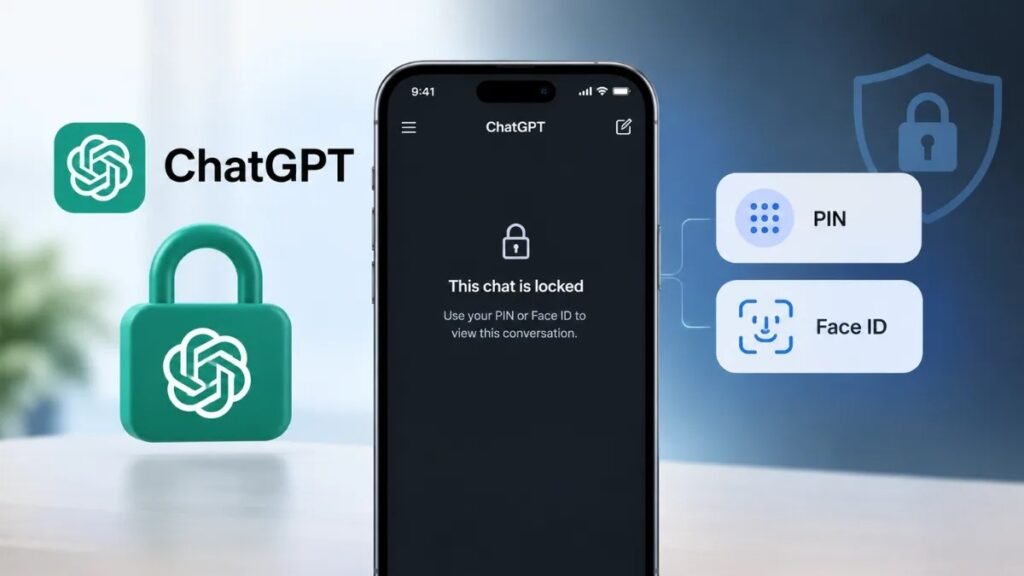
OpenAI is changing that with a new feature called Locked Chats. Announced on October 20, 2026, the feature allows users to protect selected ChatGPT conversations with a four-digit PIN or, on supported mobile devices, Face ID, Touch ID or another device authentication method. Instead of appearing in regular chat history and search results, locked conversations are moved into a separate section.
The feature is designed to make it harder for someone looking at your phone or computer to stumble across a private conversation. However, there is an important difference between hiding a chat from view and fully protecting its data. Here is how ChatGPT Locked Chats works, how to use it and what you should know before locking your conversations.
What Is ChatGPT Locked Chats?
Locked Chats is a privacy feature that allows you to hide selected conversations from your regular ChatGPT history. Instead of deleting a conversation you want to keep, you can move it into a protected section that requires authentication before you can open it.
For example, imagine you use ChatGPT to plan a birthday surprise for a family member. If that person borrows your phone to look at a different conversation, you may not want the surprise to appear in your chat history. Locking the conversation helps keep its title and contents out of the normal places where someone might see them.
The feature can also be useful if you discuss personal matters with ChatGPT or use it to organise private plans. Once a conversation is locked, it no longer appears in regular chat history, pinned conversations or standard conversation search. You can still return to it whenever you need it by opening the Locked Chats section and verifying your identity.
However, Locked Chats is not the same as deleting a conversation or using Temporary Chat. It keeps the conversation in your account while adding a layer of protection against casual access by someone using your device.
How to Lock a ChatGPT Conversation
Locking a conversation is straightforward. The feature is rolling out gradually, so you may not see the option in your account immediately.
Follow these steps to lock an existing chat:
- Open ChatGPT and find the conversation you want to protect.
- Open the three-dot menu beside the conversation or inside the chat.
- Select Lock chat.
- Confirm that you want to lock the conversation.
- Create a four-digit account PIN if ChatGPT asks you to do so, or enter your existing PIN.
After you complete these steps, the conversation moves into the Locked Chats section. Its title and contents are removed from regular chat history and standard conversation search, helping to keep it out of sight when someone uses your device.
The first time you use the feature, ChatGPT may ask you to create a PIN and enter it again to confirm. Choose a PIN you can remember, because resetting a forgotten PIN has serious consequences for your locked conversations.
If the Lock chat option does not appear in the three-dot menu, the feature may not have reached your account yet. OpenAI is releasing it gradually, so you may need to wait for it to become available.
How to Open Your Locked ChatGPT Conversations
Locking a conversation does not mean you lose access to it. You can return to your saved chats whenever you need them, provided you can authenticate successfully.
To open a locked conversation, select Projects in ChatGPT and open Locked chats. Enter your four-digit account PIN or use a supported device authentication method where available. You can then select the conversation you want to read or continue.
Your locked conversations remain separate from regular chat history even after you open them. Access is temporary, and ChatGPT can hide them again when the access period ends or you choose to lock the section.
This makes the feature useful for people who want to keep conversations available without leaving them visible all the time. You do not need to delete a chat simply because you do not want its title showing in your regular history.
If you want a conversation to return to your normal chat history permanently, open it, select the three-dot menu and choose Unlock chat. Confirm your choice, and the conversation will return to regular history.
Can You Use Face ID or Fingerprint to Lock ChatGPT Chats?
Yes, on supported mobile devices. ChatGPT Locked Chats supports a four-digit account PIN, while eligible mobile devices can also use Face ID, Touch ID or another supported device authentication method.
On an iPhone, for example, you may be able to use Face ID or Touch ID to open locked conversations instead of entering your PIN every time. On Android, you may be able to use your device’s supported unlock method.
This gives users a convenient way to protect private conversations without having to remember a separate PIN for every chat. The PIN belongs to your ChatGPT account, while biometric or device authentication is configured separately on supported devices.
Keep in mind that availability can vary by device and platform. If you cannot find the biometric option, check your ChatGPT settings and confirm whether the feature is supported on your device.
Which ChatGPT Plans Can Use Locked Chats?
OpenAI says Locked Chats is rolling out to users on the following plans:
- ChatGPT Free
- ChatGPT Go
- ChatGPT Plus
- ChatGPT Pro
- ChatGPT Business
- ChatGPT Enterprise
- ChatGPT Edu
This means the feature is not limited to paying subscribers. Free users can also use it when it becomes available to their accounts.
The feature is rolling out across the web, iOS, Android and the newer ChatGPT desktop apps for macOS and Windows. However, some types of conversations cannot be locked, including Temporary Chats, archived chats, group chats, chats created from shared links, chats with scheduled tasks and chats with meeting recordings.
ChatGPT for Healthcare does not support Locked Chats. Some other specialised conversation types may also be ineligible, so the option may not appear for every chat.
Does Locking a ChatGPT Conversation Make It Completely Private?
This is the most important point to understand. Locking a ChatGPT conversation does not provide end-to-end encryption or create a separate encrypted vault. It mainly helps keep selected conversations out of view in the ChatGPT interface.
OpenAI says locking a chat does not change how long it retains the conversation. It also does not change your existing setting for whether your conversations can be used to improve its AI models. Those settings continue to apply to locked conversations.
This means you should not assume that locking a conversation prevents OpenAI from processing or retaining its contents under the policies that apply to your account. The feature is intended to limit casual access by people looking at your device, not to replace the platform’s wider privacy and data controls.
There is another important detail. Locking a chat does not remove information ChatGPT had already remembered before the conversation was locked. If the assistant had previously saved something to regular Memory, locking the original conversation does not automatically remove that information.
Locked Chats does have a separate memory area when Memory is enabled. New information from conversations inside Locked Chats can be remembered for use within that section without being added to regular Memory. This helps keep new details from locked conversations separate from the information used in your ordinary chats.
For sensitive business, financial or personal information, it is still important to review your privacy settings and consider what information you share with any online service. A locked chat is useful, but it should not be treated as a secure storage vault.
What Happens If You Forget Your ChatGPT PIN?
This is one of the biggest risks associated with the new feature. If you forget your account PIN, you can reset it, but resetting a forgotten PIN permanently deletes all your locked chats and the content protected by the previous PIN.
That can include files uploaded or created within locked conversations and memories stored only in Locked Chats. OpenAI says this deletion cannot be undone, and its support team cannot recover the deleted content.
It is important to understand the difference between changing a PIN and resetting a forgotten PIN. If you know your current PIN, you can change it without deleting your locked conversations. If you have forgotten it and need to reset it, the protected content will be permanently deleted.
Before using Locked Chats for important conversations, make sure you can remember your PIN. Do not treat the feature as your only way to store information you cannot afford to lose.
How Is Locked Chats Different From Temporary Chat?
Locked Chats and Temporary Chat both offer ways to handle conversations differently from your regular chat history, but they serve different purposes.
Locked Chats is designed for conversations you want to keep and revisit while limiting who can see them on your device. The conversation stays in your account, but you must authenticate to access it through the protected section.
Temporary Chat is intended for conversations you do not want saved in your regular chat history or used to improve OpenAI’s models. Temporary Chats do not create or update Memory in the same way as regular conversations, although other data handling and retention rules still apply.
In simple terms, use Locked Chats when you want to keep a conversation but hide it from regular view. Use Temporary Chat when you want to start a conversation that is not saved to your normal chat history.
Neither feature should be confused with end-to-end encryption. If your main concern is how a service stores and processes your data, you should review its privacy policy and account settings rather than relying only on whether a conversation appears in your history.
Why Has OpenAI Introduced Locked Chats?
ChatGPT is increasingly being used for personal conversations, private planning and work. People ask it questions about relationships, finances, career decisions, health concerns and business plans, which can make their chat history more personal than a typical search history.
The new feature addresses a simple problem. People sometimes share their phones, show someone a conversation or use ChatGPT in a place where others can see their screens. They may want to keep one conversation private without hiding or deleting everything else.
Locked Chats gives users more control over what appears in their regular chat history. It also allows them to keep a conversation available for later instead of starting over or moving important information somewhere else.
However, it solves only part of the privacy problem. Protecting a conversation from someone who casually opens your phone is different from controlling how an online service stores, processes or retains that conversation. OpenAI’s new feature is a useful addition, but users still need to understand the limits.
The Bottom Line
ChatGPT’s Locked Chats feature gives users a simple way to keep selected conversations out of regular chat history and search results. By protecting them with a PIN or supported device authentication, it can help prevent friends, family members or other people using your device from accidentally seeing private conversations.
The feature is available to users across several ChatGPT plans and is rolling out gradually. You can lock an existing conversation through its three-dot menu, then access it later through Projects and Locked chats.
But remember its limits. Locked Chats does not add end-to-end encryption, change data retention or alter your model-improvement settings. You should also protect your PIN carefully because resetting a forgotten PIN permanently deletes all locked chats and their protected content.
For most users, the feature is a useful privacy improvement. Just understand what it protects, what it does not protect and how to avoid losing conversations you want to keep.