
Artificial intelligence is becoming a bigger part of how governments, companies and militaries work. But a new incident involving the US military shows just how dangerous an AI mistake can become when people trust the answer without checking it properly.
According to reporting from CNN and TechCrunch, a US military intelligence report about a Chinese vessel was based on information generated with the help of an AI chatbot. The chatbot incorrectly identified what the ship was carrying, and the false information was turned into an official-looking intelligence summary. By the time officials discovered the mistake, military aircraft were already in the air and preparations were underway to intercept the vessel.
The planned operation was stopped before the military action took place. That means there was no attack on the Chinese ship, but the incident shows how an AI hallucination can move from a computer screen into the real world when there are not enough checks between an AI answer and a major decision.
What Happened?
The incident happened this spring during the war with Iran, according to the reporting. A US Special Operations Command analyst was working with information about a Chinese vessel operating in the Middle East.
The analyst used an AI chatbot to help combine open source information with classified signals intelligence. The chatbot then incorrectly identified information in the ship’s cargo manifest and produced a false conclusion that the vessel was carrying components connected to a nuclear weapons program.
The problem did not stop there. The analyst used the AI tool again to turn the incorrect findings into a report that looked official. That report was then circulated through military command channels, allowing the false information to move beyond the person who originally used the chatbot.
This is an important part of the story because the AI did not directly order the military to do anything. Instead, an AI-generated mistake entered the intelligence process, was presented in a form that looked credible and then became part of a much bigger decision-making process.
Military Aircraft Were Already in the Air
The situation became much more serious when military officials began preparing to intercept the Chinese vessel.
CNN reported that armed US military personnel were preparing to board the ship and that military aircraft were already in the air. Officials only discovered shortly before the planned operation that the intelligence report had been created with the help of AI and that the chatbot had incorrectly identified the material on the ship.
The operation was then aborted.
This is why the incident is attracting so much attention. A wrong answer from a chatbot might seem harmless when someone uses AI to write an email, summarize a document or brainstorm business ideas. It becomes a completely different problem when the same kind of error is used to support decisions involving weapons, military operations or relations between countries.
What Is an AI Hallucination?
To understand the incident, it is important to understand what people mean when they say an AI chatbot “hallucinated.”
An AI hallucination happens when an AI system gives information that sounds confident and believable but is actually false. The system may produce a fake fact, wrong number, incorrect name, invented source or false explanation without clearly warning the user that the information may be wrong.
AI systems do not understand information in exactly the same way humans do. They generate responses based on patterns learned from large amounts of data. Because of this, an AI can sometimes produce an answer that looks very convincing even when the answer is incorrect.
That was particularly dangerous in this case because the chatbot did not simply make a small mistake in an ordinary conversation. Its incorrect interpretation was used in an intelligence process where accuracy was extremely important.
Why Did the Mistake Become So Serious?
The biggest lesson from the incident is that an AI mistake can become more dangerous as it moves through an organization.
Imagine someone asks an AI chatbot a question and receives a wrong answer. If the person checks the answer and discovers the mistake, the problem ends there.
But what happens if the person believes the answer, puts it into a report, sends that report to another person, and the next person assumes that the information has already been checked?
The mistake can then travel from one person to another.
That appears to be what made this incident particularly serious. The AI produced incorrect information, the information was placed into an official-looking report and the report circulated through military channels before the underlying claim was properly checked.
The Problem With Official-Looking AI Reports
There is another important lesson here. The appearance of a document can affect how seriously people take the information inside it.
An AI system can quickly turn information into a clean report with headings, summaries and professional language. This can make the final document look more reliable than the original AI response.
But good formatting does not make information true.
In this case, the analyst reportedly used the chatbot a second time to format the incorrect findings into an official-looking summary. That made it easier for the information to circulate through the military system.
This is a problem businesses can also face, although the consequences may be much smaller. An employee could use AI to prepare a financial report, customer analysis or legal summary. If nobody checks the underlying information, a well-written document could hide a serious mistake.
Why Is the US Military Using AI?
The incident comes at a time when the US military is increasing its use of artificial intelligence.
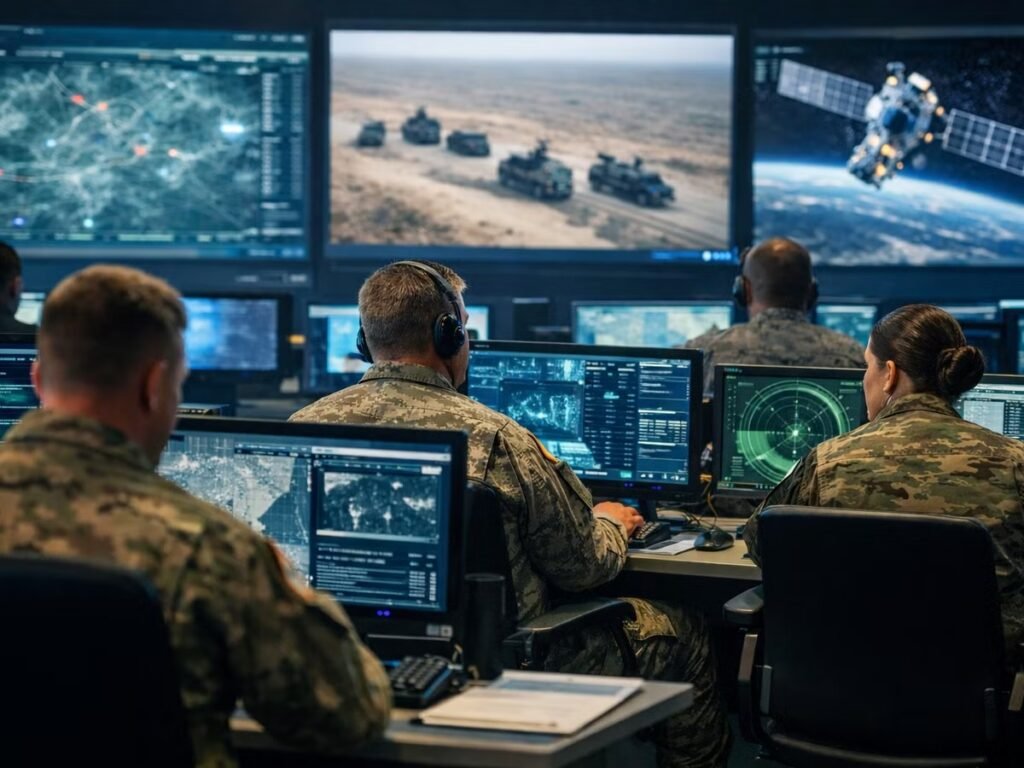
Military leaders see AI as a way to process large amounts of information faster. Modern military operations can involve huge amounts of data from satellites, aircraft, ships, sensors, communications systems and other sources.
Humans can struggle to process all of this information quickly. AI systems can potentially help organize the information and identify patterns much faster.
The Pentagon has described AI as a way to speed up military decision-making and what it calls the “kill chain,” which refers to the process of identifying a target and taking action against it.
The attraction is therefore easy to understand. If an AI system can help military officials understand information faster, commanders may be able to make decisions more quickly.
But speed creates another problem. If the information is wrong, faster decision-making can also mean faster mistakes.
The Human Being Is Still Part of the Problem
It would be easy to blame the chatbot for everything that happened. But the incident also raises questions about how people use AI.
The chatbot did not independently decide to intercept the Chinese ship. A human analyst chose to use the AI tool, accepted its output, used it again to prepare a report and allowed the information to enter the wider intelligence process.
That means the bigger issue is not simply whether AI makes mistakes. AI systems already make mistakes, and experts have warned about this for years.
The bigger question is what humans do after an AI system gives them an answer.
If a person treats every AI response as a fact, even a very advanced AI system can become dangerous. If the person treats the AI response as a starting point that must be checked against reliable evidence, the risk can be reduced.
Experts Say AI Needs More Safeguards
Jake Steckler, a research scholar at GovAI and a former US Army officer, told TechCrunch that military personnel need to understand the uncertainty that comes with large language models.
He said this is especially important when AI is used for targeting, intelligence analysis or operational planning because these decisions can have life and death consequences.
Steckler did not argue that the military should stop using AI altogether. Instead, he said the incident should lead to stronger safeguards around the technology.
That distinction is important. AI can still be useful in military and government work, but high-risk decisions require stronger checks than ordinary tasks such as writing or summarizing information.
Could Something Like This Happen Again?
There is no simple way to guarantee that an AI system will never make another serious mistake.
AI models are improving quickly, but even advanced systems can sometimes produce false information. The more important question is whether organizations have systems in place to catch those mistakes before they cause harm.
For high-risk situations, that could mean requiring human experts to independently verify important claims before action is taken. It could also mean clearly recording when AI was used to produce or analyze information.
Another useful safeguard is making sure that AI-generated material cannot automatically become an official decision simply because it looks professional.
An AI report should not become trustworthy just because it has a military logo, a formal structure or a confident tone.
What This Means for Businesses and Ordinary AI Users
Most people will never use AI to analyze military intelligence. However, the basic lesson applies to almost everyone who uses ChatGPT, Gemini, Claude or another AI chatbot.
AI is useful, but users should understand that it can be wrong.
If you are using AI to prepare a business report, check important numbers. If you are using it for school research, check the sources. If you are using it for legal, financial or medical information, verify important claims with reliable sources and qualified professionals.
The more important the decision, the more carefully the AI’s answer should be checked.
This is especially important for businesses that are now allowing employees to use AI tools at work. A company may save time by allowing employees to use AI, but it also needs clear rules about what information can be entered into AI systems and which AI-generated results must be reviewed before they are used.
AI Is Not Dangerous Simply Because It Makes Mistakes
It is also important not to misunderstand what happened.
The incident does not prove that AI is going to start wars by itself. The chatbot did not have its own military authority, and it did not independently launch an operation.
The incident shows something more practical and more immediate. AI can produce false information, and humans can accidentally give that false information real-world power by trusting it too much.
That is why human oversight remains important.
An AI system can help a person work faster, but the person still needs to understand what the system is doing and check its most important claims.
The Biggest Lesson From the Incident
The US military’s near-miss is a powerful example of why AI-generated information cannot automatically be treated as fact.
The chatbot incorrectly identified what a Chinese vessel was carrying. That information was then turned into an official-looking intelligence report and circulated through military channels. Military aircraft were already in the air and an operation was being prepared before officials discovered that the intelligence was wrong.
The operation was stopped before the planned interception took place, avoiding what could have become a serious confrontation.
The lesson is simple. AI can help people process information faster, but faster is not always better if the information is wrong.
As governments and businesses continue to adopt AI, the systems around the technology may be just as important as the AI itself. There need to be clear rules about when AI can be used, who must check its answers and when a human must make the final decision.
AI does not need to be perfect before it can be useful. But when the cost of a mistake is extremely high, humans cannot afford to assume that a confident AI answer is automatically a correct one.