
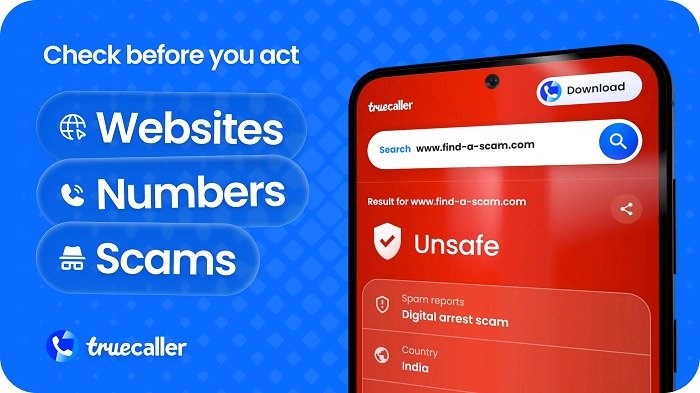
Imagine receiving a message on WhatsApp saying your bank account will be blocked unless you click a link immediately. The message looks real, the phone number looks familiar, and you are not sure what to do. Instead of clicking the link and hoping for the best, you could soon paste the link or message into Truecaller’s new Scam Checker to see whether it has been linked to fraud.
This is the idea behind Truecaller Scam Checker, a new tool that takes Truecaller’s scam protection beyond phone calls. The Swedish company says the new service can check suspicious phone numbers, web links and messages, giving people another way to spot possible scams before they respond.
For more than a decade, Truecaller has been known mainly as an app that tells people who is calling and helps identify spam calls. But scams are no longer limited to phone calls. Fraudsters now use SMS, WhatsApp, social media, fake websites and other online channels, so Truecaller is expanding its approach to follow scammers into these places.
What Is Truecaller Scam Checker?
Truecaller Scam Checker is a new web and Android service that allows people to check suspicious phone numbers, links and messages. The service is designed to work without requiring users to download the main Truecaller app or create an account when using the web version.
The idea is very simple. If someone sends you a strange link or message and you are not sure whether it is safe, you can copy it and submit it to Scam Checker. Truecaller then checks the information against its risk database and other signals, while also looking at reports from its user community.
For messages, the system can identify phone numbers or links inside the message and check them. This means you do not necessarily have to figure out which part of a long suspicious message is important before checking it.
Truecaller says the new service is initially available in India and will later expand to Latin America, the Middle East and Africa, as well as Southeast Asia.
How Does Truecaller Scam Checker Work?
One of the interesting parts of the new tool is how it checks links.
When you submit a link, Scam Checker can expand shortened URLs and follow redirects to find the final destination of the link. It then compares the destination with Truecaller’s own risk database and other fraud signals to help determine whether the link may be dangerous.
This is useful because scammers often hide the real destination of a website. A link may look harmless at first, but it could eventually take you to a fake banking website, a fake shopping page or another site designed to steal your information.
The tool also uses Truecaller’s ScamFeed community. ScamFeed contains reports from users who share information about scams they have encountered. If a phone number, link or message has been connected to previous reports, that information can help users understand what they may be dealing with.
However, there is an important difference between Scam Checker and the main Truecaller service. While Scam Checker can help identify suspicious numbers and show related scam reports, more detailed information about a phone number, including the name connected to it, remains available through Truecaller’s existing service, which requires users to sign in.
Why Is Truecaller Expanding Beyond Caller ID?
The simple reason is that scammers have changed the way they operate.
Years ago, a scam might start with a suspicious phone call from an unknown number. Today, a scam can begin with a WhatsApp message, an SMS, an email, a social media post or a link shared by someone pretending to be a bank, delivery company or government agency.
This makes caller ID alone less useful as a complete protection system. Truecaller CEO Rishit Jhunjhunwala explained that people often receive suspicious content somewhere else and then search online to find out whether it is real.
Truecaller estimates that people conduct about 14 million web searches every month to check suspicious links and phone numbers. The company says this behavior helped inspire Scam Checker because it saw an opportunity to give people a direct place to perform those checks.
The change also reflects a wider problem. Fraudsters are increasingly using several communication channels at the same time, which means protecting people from scams requires more than simply identifying unknown callers.
Scams Are Moving to WhatsApp, SMS and Other Platforms
Data cited by TechCrunch shows how important messaging platforms have become to online fraud.
A 2025 GSMA survey of Indian adults who reported being scammed found that 46% said they were approached through messaging apps. Another 37% said they were contacted through SMS, while 32% said voice calls were involved.
The numbers show why a service that only checks phone calls may not be enough anymore. Someone may receive a genuine-looking message from a scammer and only discover the danger after clicking a link or sending money.
This is particularly important in countries where messaging apps are widely used for banking, shopping, business and everyday communication. A scammer does not need to call someone if a convincing WhatsApp message can do the same job.
Truecaller’s new approach is therefore aimed at the point where people often become suspicious. Instead of waiting for someone to receive a call, the company wants to help them check suspicious information wherever they encounter it.
Truecaller Already Has a Large Scam Database
The company is also using the information collected from its large community of users.
Truecaller says about 20,000 scam reports are currently live on ScamFeed in India, with around 1,300 new reports being added each week. This gives the company a growing collection of real-world information about the scams people are seeing.
Truecaller also said that between September 14 and September 20, it evaluated 12.9 billion messages globally and flagged 20.3 million as fraudulent. These figures show the scale of the problem the company is trying to address, although users should still understand that no automated scam detection system can identify every scam perfectly.
The community side is especially useful because scams can change quickly. A fraudster may create a new phone number or website today, use it for a short period and then abandon it. Reports from people who encounter those scams can help create a faster picture of what is happening.
Truecaller Plans to Add More Features
Scam Checker is not the final version of Truecaller’s plan.
The company says it intends to expand the types of scams the service can detect. It is also planning to add the ability for users to upload screenshots for further analysis.
That could be particularly useful because many scams arrive as screenshots, images or messages that contain several pieces of information. A screenshot upload feature could allow users to submit the entire conversation or suspicious page instead of copying information manually.
The company is also looking at how its scam intelligence can support its wider business. Truecaller sells fraud and risk products to businesses through Truecaller for Business, although the company says Scam Checker itself is aimed at consumers.
Truecaller Is Facing More Competition in Caller ID
There is another reason this move matters for Truecaller.
Caller ID has traditionally been the company’s main product, but the business is facing new competition. In India, telecom operators are rolling out a government-backed Calling Name Presentation service, while Apple and Google have also introduced their own caller identification and spam protection features.
That means Truecaller cannot simply depend on being the app people use to identify unknown callers. If phones and telecom networks can increasingly provide similar information, Truecaller needs to offer more value.
Scam detection gives the company another area to focus on. Instead of asking only, “Who is calling me?”, Truecaller wants to help answer a much bigger question, “Is this thing someone sent me trying to scam me?”
What This Means for People in Africa
Truecaller’s plan to expand Scam Checker to Africa is particularly important because the company says the service will eventually be available across the region. The exact timing of that expansion was not provided in the announcement, so users outside the initial launch market will need to wait for availability in their country.
For users who regularly receive suspicious WhatsApp messages, SMS messages and links, a simple web-based checking tool could be useful. It could provide another step between receiving a suspicious message and deciding whether to click, reply or send money.
However, people should not treat Scam Checker as a guarantee that a link or message is safe. Even if a phone number or website has not been reported before, that does not automatically mean it is genuine.
Basic safety rules still matter. Do not send passwords, PINs or one-time passwords to people who ask for them, and do not rush to click a link simply because a message says something is urgent.
Truecaller Wants to Follow Scammers Wherever They Go
Truecaller’s latest move shows how much the fight against scams has changed.
The company started with a relatively simple problem, helping people identify unknown callers. But scammers have moved far beyond phone calls, and they now use messages, links, social media and other online tools to reach victims.
Scam Checker is Truecaller’s attempt to respond to that change by bringing its scam intelligence to the wider internet. Users can check suspicious links, phone numbers and messages, while the service also draws on reports from Truecaller’s large community.
The company still has a long way to go, especially as scammers continue to change their methods. But with plans to expand Scam Checker to more regions and add features such as screenshot analysis, Truecaller is clearly trying to become more than a caller ID app.
For anyone who has ever received a strange message and wondered, “Is this a scam?”, that could become one of the most important changes to Truecaller’s service yet.