
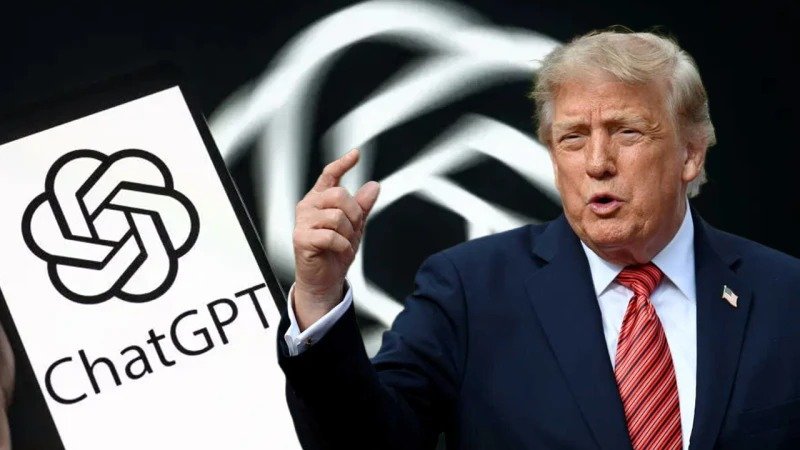
Artificial intelligence could soon have a new name if President Donald Trump gets his way. On September 19, Trump asked his followers on Truth Social to vote on three possible names for artificial intelligence, while also announcing plans to create what he called an “AI Force” and appoint an AI “czar”.
The announcement comes at a time when the United States is having a major debate about the future of AI. Some technology leaders and researchers are warning about the risks of increasingly powerful AI systems, while Trump has argued that the United States should continue developing the technology quickly so it does not fall behind China.
Here is everything you need to know about Trump’s proposed AI name change, the new AI Force, and the person he plans to appoint as AI czar.
Trump Wants to Change the Name of Artificial Intelligence
The first part of Trump’s announcement was about something most people probably did not expect, changing the name of artificial intelligence.
Trump said many people believe the words “Artificial Intelligence” are inaccurate and not very elegant. He then suggested three possible alternatives and asked his followers to vote for their preferred option.
The three names are:
- Superior Intelligence
- Extreme Intelligence
- Supreme Intelligence
Trump presented the idea as a way of giving the technology a name that he believes better describes its growing abilities.
For now, this is only a proposal. There is no indication that the technology industry, the US government, or major AI companies are actually preparing to stop using the term artificial intelligence.
In everyday life, the name AI is already deeply established. Companies such as OpenAI, Google, Microsoft, Meta and Anthropic use the term across their products, research and marketing. Changing the name would therefore be much bigger than simply changing a word in government documents.
Trump’s poll was still running when the announcement was reported, so there was no final decision on which name, if any, would be adopted.
Why Does Trump Want to Rename AI?
Trump’s proposed name change is connected to his wider view of artificial intelligence.
In his posts, Trump argued that concerns about stopping or slowing AI are part of what he described as political attacks against the technology. He said his administration would not allow efforts to destroy the AI industry and said the United States should continue supporting its growth.
Trump has also described AI as a major economic opportunity. In his September 19 statement, he compared the technology with major changes such as the Industrial Revolution and the rise of the internet. He suggested that AI could eventually have a very large effect on the US economy, although such economic projections are his own claims rather than established forecasts.
This is important because the debate over AI is no longer just about chatbots such as ChatGPT. AI is now connected to jobs, data centers, computer chips, national security, energy use, education, business and the competition between the United States and China.
That makes the question of how governments manage AI much more important than what the technology is called.
What Is Trump’s New “AI Force”?
The second part of Trump’s announcement is more significant.
Trump said he is creating an “AI Force”, comparing the idea with the United States Space Force, which was established during his first term as president. However, he did not explain exactly what the AI Force will be.
There are currently no detailed public plans explaining whether the AI Force would be a military organisation, a government task force, a civilian agency, or something else.
Trump also did not provide information about its budget, staff, headquarters, legal authority or exact responsibilities. The White House had not provided further details when the announcement was reported.
This means people should be careful about assuming that the AI Force will operate like the Space Force.
For now, all that is clear is that Trump wants to create a new government effort focused on AI and has compared it with the Space Force.
The actual structure will depend on what the administration announces next and whether Congress would need to approve any new agency or authority.
Trump Also Plans to Appoint an AI Czar
Trump also announced that he will appoint an AI “czar”.
In simple terms, an AI czar would be a senior government official responsible for coordinating the administration’s work on artificial intelligence. However, Trump has not yet explained exactly what powers the person will have.
Trump said the announcement would come in the near future and added that only people with high intelligence should apply for the position. He did not name a candidate.
This would not be Trump’s first AI czar.
Venture capitalist David Sacks previously served as Trump’s AI and crypto czar before stepping away from that role earlier in 2026. Sacks continues to have a role as co-chair of the President’s Council of Advisors on Science and Technology.
The new position therefore appears to be part of a broader effort to reorganise how the Trump administration handles AI.
Why Is This Happening Now?
The timing of Trump’s announcement is important.
The United States is currently experiencing a major argument over how quickly AI should develop and how much government oversight is needed.
Some researchers and technology executives have raised concerns about the possibility that increasingly powerful AI systems could create serious risks. The debate became more intense recently after former Anthropic researcher Jacob Coxon left the company and publicly raised concerns about the risks associated with advanced AI development.
Anthropic CEO Dario Amodei has also proposed measures aimed at reducing some of the risks associated with advanced AI systems. OpenAI CEO Sam Altman and SpaceX CEO Elon Musk have expressed support for parts of the discussion around AI safety.
Trump, however, has taken a different position on the broader debate. He has argued that the United States should not slow down AI development and has described some of the opposition to the industry as politically motivated.
This does not mean that Trump is saying AI should have no rules at all. His recent comments indicate that he believes existing criminal and civil laws can be used to deal with harmful behaviour, rather than creating broad new restrictions specifically for AI.
The US Is Also Competing With China on AI
Another major part of the story is the competition between the United States and China.
Both countries are investing heavily in artificial intelligence, including AI models, computer chips, data centers and other technology needed to run powerful systems.
Trump has repeatedly stressed the importance of keeping the United States ahead of China in AI. His latest announcement comes shortly before an expected meeting with Chinese President Xi Jinping, where AI is among the wider areas of US-China economic and technology competition.
The US government is therefore dealing with two issues at the same time. It wants American companies to remain competitive in AI, while officials and experts are also debating how to deal with possible risks from increasingly powerful systems.
The creation of an AI Force and the appointment of an AI czar could become part of that wider strategy.
What Could the AI Force Actually Do?
At this point, there is no confirmed answer.
Trump has not publicly listed the responsibilities of the AI Force, so any detailed description of its future work would be speculation.
Depending on how the administration structures it, the new organisation could potentially focus on areas such as AI security, government use of AI, protection of critical infrastructure, research, national competitiveness or enforcement against harmful uses of AI. However, none of these responsibilities has been officially confirmed.
This is why the next announcements will matter more than the name itself.
If the AI Force receives real legal authority, funding and staff, it could become an important part of US technology policy. If it remains mainly a coordinating group, its influence could be much smaller.
What Trump’s AI Announcement Means for Businesses and AI Users
For ordinary AI users, Trump’s proposed name change will probably have little immediate effect.
ChatGPT will still be ChatGPT. Gemini will still be Gemini. AI image generators, video tools and coding assistants will continue to operate under their existing names.
The bigger issue is what happens to AI policy.
Businesses that use AI need to pay attention to government rules because changes in areas such as data privacy, copyright, AI safety, employment and computer infrastructure can affect how companies build and use AI tools.
AI companies will also be watching the new AI Force and AI czar closely. Their responsibilities could influence how the US government approaches the rapidly growing industry.
For now, however, the details remain limited.
The Biggest Question Is What Comes Next
Trump’s announcement has created attention because it combines three unusual ideas in one story, renaming artificial intelligence, creating an AI Force and appointing an AI czar.
The name change is currently just a proposal, with Trump asking his followers to choose between Superior Intelligence, Extreme Intelligence and Supreme Intelligence. There is no confirmed plan for the technology industry to adopt any of these names.
The AI Force is also still largely undefined. Trump has compared it with the Space Force, but has not explained its structure, powers or responsibilities.
The AI czar is similarly yet to be named.
What happens next will show whether these announcements become lasting parts of US AI policy or remain early proposals that change as the administration develops its plans.
For now, one thing is clear, the US government is putting AI at the centre of its economic and technology strategy, while the debate over how quickly the technology should develop and how it should be controlled is becoming more important.