
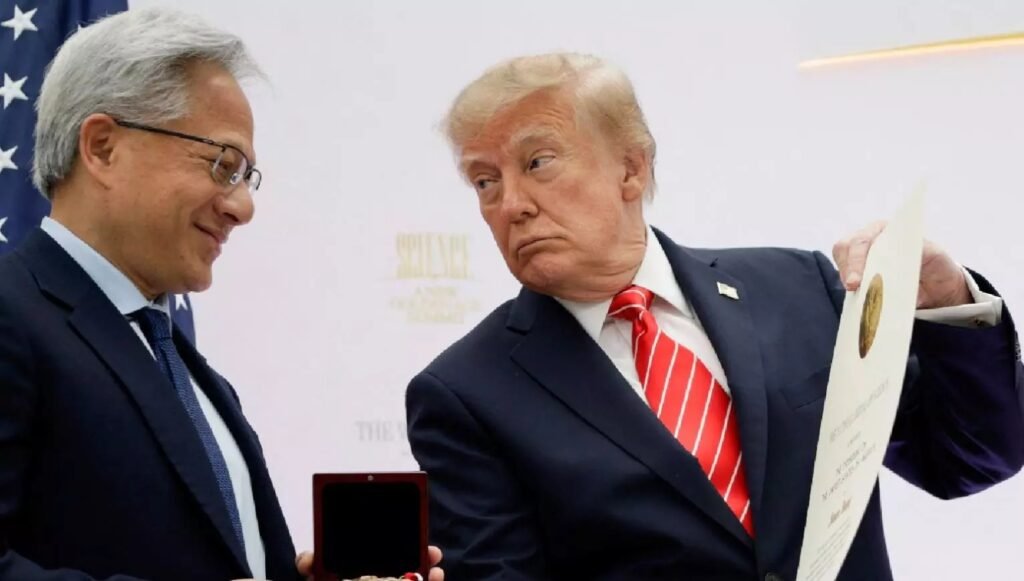
Nvidia CEO Jensen Huang is facing one of the biggest leadership challenges of his career after reports linked his personal relationship with a technology executive to an alleged Chinese intelligence operation. The controversy has prompted Nvidia’s board of directors to launch an independent investigation into whether Huang was targeted by foreign intelligence agents and whether any company secrets or sensitive information were exposed.
The situation is attracting attention because Nvidia is not an ordinary technology company. It is the world’s leading supplier of advanced AI chips, and its products power many of the artificial intelligence systems being developed by companies such as OpenAI, Microsoft, Google, Meta, and Amazon. A leadership crisis at Nvidia could therefore have consequences that extend far beyond the company itself.
The controversy has also raised questions about whether Huang can continue leading Nvidia while the investigation is ongoing. Yale professor Jeffrey Sonnenfeld has estimated that the chances of Huang keeping his position are approximately 50-50. This is his personal assessment, not an official position from Nvidia’s board, which has publicly expressed confidence in the CEO.
What Happened Between Nvidia CEO Jensen Huang and the Suspected Chinese Spy?
The controversy centres on Alice Huang, a former executive at Megaspeed, a Singapore-based technology company involved in the semiconductor industry.
According to reports based on a US intelligence memo, Alice Huang was allegedly recruited by China’s Ministry of State Security to gather information from Nvidia CEO Jensen Huang. The memo reportedly claimed that she developed a romantic relationship with the Nvidia CEO as part of the alleged intelligence operation.
These claims have not been proven in court, and no one has been charged in connection with the allegations. They are based on intelligence claims reported by several media organisations, rather than a publicly established finding of espionage.
The issue became more serious after Jensen Huang acknowledged that he had been unfaithful to his wife. In a message to Nvidia employees, he apologised to his family, colleagues, board members, partners, and shareholders.
Huang said his actions had hurt his wife and children and accepted responsibility for his behaviour. He also acknowledged that he had fallen short of his responsibilities to Nvidia.
Although Huang’s apology did not mention Alice Huang by name, TechCrunch reported that the admission was connected to the reports about his relationship with the former Megaspeed executive.
The Chinese Embassy in Washington rejected the espionage allegations, describing them as groundless accusations. Nvidia has also previously said that Huang’s interactions with Alice Huang were not unusual and that the company does not share classified information with its customers.
Nvidia Launches an Independent Investigation
Following the reports, Nvidia’s board of directors announced on November 8, 2026, that it was launching an independent investigation into the matter.
The investigation will be handled by a committee made up of independent board members, with assistance from external legal advisers. This means the review is intended to be conducted separately from Huang’s direct leadership responsibilities.
In its official statement, Nvidia said it had no reason to believe that national security information or company secrets had been compromised. However, the board wants to examine all available information to understand what happened and whether the allegations have any basis.
The board also confirmed that Jensen Huang supports the investigation and has agreed to cooperate fully. It added that it continues to have confidence in Huang and his leadership team.
This statement is important because Nvidia has not announced Huang’s suspension or removal. He remains the company’s CEO while the investigation continues.
However, the decision to launch an independent review shows that the board considers the allegations serious enough to require a formal examination. The outcome could influence how the company handles its leadership, security policies, and relationships with international business partners.
Who Is Alice Huang and What Is Her Connection to Nvidia?
Alice Huang is described in reports as a former executive at Megaspeed, a Singapore-based company involved in cloud computing and semiconductor-related business.
Megaspeed is particularly important because of its reported relationship with Nvidia. The company became one of Nvidia’s major customers in Southeast Asia and reportedly purchased approximately $2 billion worth of Nvidia chips, according to reporting cited by The New York Times.
This business relationship has attracted attention because of growing concerns about the movement of advanced American technology into China.
The United States has placed restrictions on the export of certain advanced computer chips to China because of national security concerns. These restrictions are designed to limit China’s access to computing technology that could support advanced military systems and other sensitive activities.
However, controlling where advanced chips eventually end up can be difficult. Companies may purchase chips through authorised channels and then transfer, rent, or resell computing access to customers in other countries.
US officials have previously raised questions about whether some Singapore-based companies could be helping Chinese businesses access restricted Nvidia technology through indirect arrangements.
The reports about Alice Huang have therefore created two connected concerns. The first is whether she was involved in an intelligence operation targeting Nvidia’s CEO. The second is whether the business relationships surrounding Megaspeed could have allowed sensitive Nvidia technology to reach unauthorised customers.
Neither concern has been conclusively established by the current investigation. Nvidia has previously said it investigated related allegations and found them to be unfounded, while its board has now announced a fresh independent review.
Could Jensen Huang Lose His Job as Nvidia CEO?
One of the biggest questions following the controversy is whether Jensen Huang could lose his position as Nvidia’s CEO.
Jeffrey Sonnenfeld, a professor at Yale School of Management and an expert on corporate leadership, believes the situation could go either way. Speaking to TechCrunch, he estimated Huang’s chances of remaining CEO at approximately 50-50.
Sonnenfeld said Huang had previously enjoyed enormous trust and respect across the technology industry. However, he described the situation as a serious example of poor judgement, especially because of the national security concerns surrounding the allegations.
His argument is that company leaders are expected to follow stricter standards because their personal decisions can affect employees, investors, customers, and the wider business. Even if Huang was unaware of any alleged intelligence operation, the circumstances surrounding the relationship could still raise questions about his judgement.
However, Sonnenfeld also believes Huang has some factors working in his favour. He has led Nvidia since co-founding the company in 1993 and has played a major role in turning it into one of the most important businesses in the global technology industry.
His long record of success could give him some protection during the investigation. But that does not guarantee he will remain in office if the board discovers evidence of serious misconduct or a failure to protect company interests.
It is important to understand that the 50-50 estimate is Sonnenfeld’s personal opinion. Nvidia has not announced that it is considering replacing Huang, and its official statement says the board continues to have confidence in him.
Why Jensen Huang’s Leadership Matters So Much to Nvidia
Jensen Huang is not simply an executive who manages Nvidia’s daily operations. He is also the company’s co-founder and one of the main figures responsible for its business direction.
Huang established Nvidia in 1993 alongside Chris Malachowsky and Curtis Priem. The company initially focused on graphics processing technology, particularly chips used in computer graphics and video games.
Over the years, Nvidia expanded into other areas of computing. Its graphics processing units, commonly called GPUs, became important tools for scientific research, data processing, machine learning, and artificial intelligence.
Today, Nvidia supplies many of the chips used to train and operate advanced AI models. Companies building AI systems depend heavily on its hardware, software, and computing platforms.
Huang has also been closely involved in Nvidia’s major business decisions, partnerships, and investments. This has made him an important figure in the company’s relationship with other technology businesses.
According to TechCrunch, Huang has maintained a relatively flat management structure, with around 60 direct reports. This means many senior executives report to him directly rather than working through several layers of management.
Such a structure can help a company make decisions quickly, but it may also create challenges when planning for leadership succession. If Huang were to leave suddenly, Nvidia would need to ensure that another executive could manage its operations and maintain confidence among employees, customers, and investors.
Why the Controversy Could Affect the Entire AI Industry
Nvidia occupies a central position in the artificial intelligence industry. Its chips are used by companies developing large AI models, building data centres, and providing cloud computing services.
OpenAI, Anthropic, Microsoft, Google, Meta, and several other technology companies depend on Nvidia’s hardware as part of their AI infrastructure. This makes the company an important supplier in an industry that is currently attracting hundreds of billions of dollars in investment.
Nvidia has also invested in several companies involved in the AI boom. These include OpenAI, Anthropic, xAI, CoreWeave, and Nebius, according to TechCrunch.
This creates a wider business risk. If Nvidia experiences a serious leadership crisis, questions could emerge about the stability of its partnerships, investment plans, and future business decisions.
However, it would be premature to assume that Huang’s position is about to cause a major disruption to the AI industry. Nvidia’s board has said it has no reason to believe that company secrets or national security information were compromised.
The company’s operations also depend on thousands of employees, engineers, managers, suppliers, and business partners. Even if its leadership structure is strongly centred around Huang, Nvidia is much larger than one individual.
The bigger concern is whether the investigation reveals weaknesses in the way the company protects sensitive business information and manages relationships with customers and external executives.
The US-China Technology War Adds Another Layer to the Problem
The allegations have emerged at a time when the United States and China are competing for leadership in artificial intelligence, semiconductor production, and advanced computing.
Computer chips have become important to national security because they are needed for advanced AI systems, military technology, scientific research, and other sensitive applications.
The United States has introduced export restrictions to limit China’s access to some advanced chips. Nvidia has been directly affected by these policies because some of its most powerful products cannot be freely sold to Chinese customers.
Huang has previously argued that allowing American companies to sell certain advanced chips to China is important for maintaining their global competitiveness. He has also warned that overly strict restrictions could encourage Chinese companies to develop their own alternatives.
However, some policymakers and technology leaders believe that allowing advanced American chips to reach China could create national security risks.
The controversy surrounding Alice Huang could therefore increase political attention on Nvidia’s business relationships in Asia. Lawmakers may want to understand how the company monitors customers, checks where its chips are used, and prevents restricted technology from reaching unauthorised users.
According to TechCrunch, three US House committee chairmen have requested a closed-door briefing from Huang scheduled for November 18, 2026. This could give lawmakers an opportunity to ask questions about the allegations and Nvidia’s security practices.
What Happens Next for Jensen Huang and Nvidia?
The immediate focus is on the independent investigation announced by Nvidia’s board. The review will need to establish what happened, examine the available evidence, and determine whether any company or national security information was exposed.
Nvidia is also expected to face questions from US lawmakers. The company’s upcoming financial results, scheduled for November 17, 2026, will attract attention because investors will want to understand whether the controversy has affected its business outlook.
For now, Huang remains CEO and continues to lead the company. There is no official announcement that he will resign or be removed from his position.
However, even if he keeps his job, the investigation could lead to changes in how Nvidia manages sensitive relationships, protects company information, and distributes decision-making responsibilities.
The company may also need to strengthen its internal security procedures, particularly for executives and employees who interact with customers, government officials, and international business partners.
The final outcome will depend on what the board discovers and whether it believes Huang can continue leading the company without damaging trust among employees, investors, customers, and government stakeholders.
The Bottom Line
Jensen Huang’s position as Nvidia CEO has come under pressure following reports that a former business executive was allegedly recruited by Chinese intelligence to gather information about him. The controversy has become more serious after Huang admitted to being unfaithful to his wife, while Nvidia’s board has launched an independent investigation into the reported foreign intelligence operation.
Although the allegations have raised questions about Huang’s judgement and the security of Nvidia’s business relationships, there is currently no established evidence that company secrets or national security information were compromised. Nvidia has said it has confidence in Huang, and he remains CEO while the investigation continues.
The situation matters because Nvidia is at the centre of the global AI industry. Its chips, investments, and partnerships support some of the world’s largest technology companies, making leadership stability an important issue for the wider market.
Whether Huang keeps his position will depend largely on the findings of the investigation and the board’s assessment of his leadership. For now, the company faces the challenge of protecting its reputation, reassuring its partners, and maintaining confidence in the business while one of the most important technology executives in the world faces serious questions about his judgement and security responsibilities.