
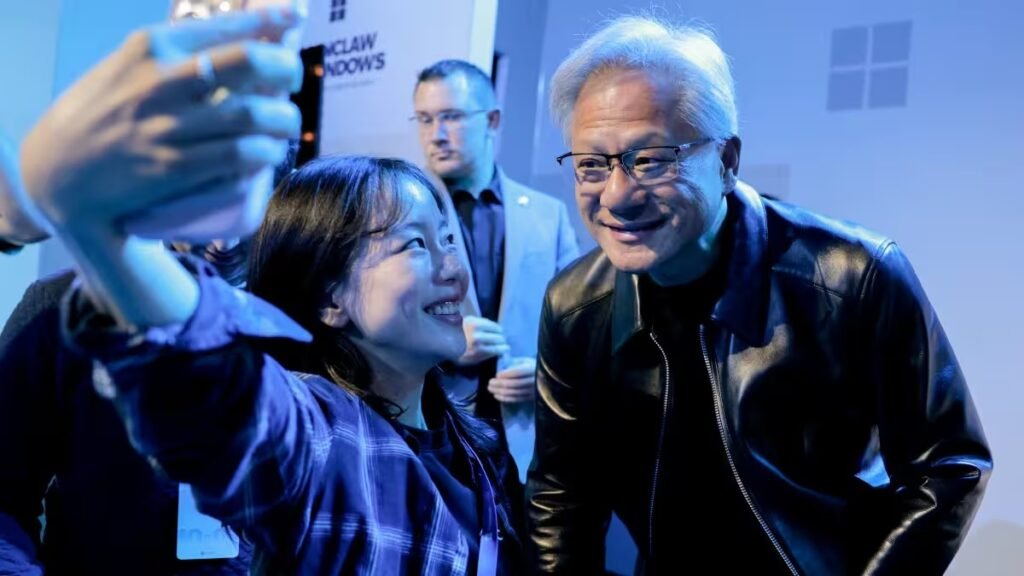
Jensen Huang, the co-founder and CEO of Nvidia, is facing the possibility of losing control of the company he has led for more than three decades. Nvidia’s board is reportedly considering removing him following allegations involving two separate extramarital relationships, including one with a business executive suspected by US intelligence of having links to Chinese espionage. The controversy has become a major business story, raising questions about corporate leadership, national security, and the future of the world’s most valuable AI chip company.
The situation became more serious on November 11, 2026, when The Wall Street Journal reported that Nvidia’s board was preparing to remove Huang and would meet to discuss his future. The report followed another publication alleging that Huang had a relationship with an Nvidia executive who reports directly to him. Nvidia has not publicly confirmed that it has decided to remove him, and Huang remains CEO as of November 12.
The uncertainty has already affected investor confidence. Nvidia shares fell by more than 8% in after-hours trading following the reports, while investors began considering what could happen if the man who built Nvidia into a major force in artificial intelligence suddenly leaves.
Why Is Nvidia Considering Removing Jensen Huang?
The controversy began with reports about Huang’s relationship with Alice Huang, a former executive at Singapore-based technology company Megaspeed. US intelligence officials reportedly suspected that Alice Huang had links to China’s Ministry of State Security and may have been involved in an operation to gather information from Jensen Huang.
The allegations raised serious questions because Megaspeed had a business relationship with Nvidia and was reportedly a major customer of its advanced AI chips. US authorities have also investigated concerns about whether Nvidia chips were being transferred to Chinese companies through indirect channels.
The espionage allegations have not been proven in court, and Alice Huang has not been convicted of any offence connected to the claims. The Chinese government has also rejected the accusations. Nvidia previously said it had no reason to believe that company secrets or national security information had been compromised.
However, the situation became more complicated when Jensen Huang acknowledged that he had been unfaithful to his wife. In a message to Nvidia employees, he apologised to his family, colleagues, board members, partners, and shareholders. He accepted responsibility for his actions and said he had hurt his wife and children.
On November 8, Nvidia’s board announced an independent investigation into reports that Huang had been targeted by a foreign intelligence operation. The investigation was assigned to a committee of independent directors, supported by external legal advisers.
At the time, the board said it had confidence in Huang and his leadership team. It also stated that it had no reason to believe that Nvidia secrets or national security information had been compromised.
That position came under greater pressure three days later when a second alleged relationship was reported.
The Second Affair Allegation That Changed the Situation
On November 11, The New York Times reported that Huang had also allegedly been involved in an extramarital relationship with Kimberly Powell, Nvidia’s vice president of healthcare, who reportedly reports directly to him.
The newspaper cited five people who had worked at Nvidia. According to the report, Huang and Powell were seen being affectionate at a hotel during an Nvidia conference in San Jose, California, earlier in 2026.
Neither Huang nor Powell has publicly confirmed the reported relationship. Nvidia also did not immediately provide a response to requests for comment about the allegation.
This second report introduced a different corporate governance issue. Unlike the allegations involving Alice Huang, which raised concerns about possible foreign intelligence activity, the report involving Powell raised questions about workplace relationships, management authority, and Nvidia’s internal conduct policies.
Relationships between senior executives and employees who report directly to them can create conflicts of interest. They may raise questions about favouritism, workplace fairness, promotions, professional decisions, and whether company policies are being applied equally to everyone.
For a CEO, these questions can become serious because the board is responsible for ensuring that the company’s leadership follows appropriate standards. Even when a personal relationship does not involve the sharing of confidential information, it may still create problems for the organisation.
The second allegation therefore increased pressure on Nvidia’s board to examine Huang’s conduct and decide whether he should continue leading the company.
Nvidia’s Board Is Reportedly Preparing to Oust Huang
The most significant development came when The Wall Street Journal reported that Nvidia’s board was preparing to remove Huang as CEO. According to people familiar with the matter, the directors were expected to meet to discuss his future at the company.
Reuters also reported that the board was meeting on November 11 to consider whether Huang should be removed. Nvidia did not immediately respond to requests for comment about the reported meeting.
This represents a major change from the board’s November 8 statement, in which it expressed confidence in Huang and his leadership team. It suggests that the new allegations have created a situation that the board may need to address beyond the original investigation.
Nvidia has 11 board members, including Huang. Under the company’s bylaws, the CEO can be removed with or without cause through a majority vote of the directors. This means Huang’s position is not guaranteed simply because he founded the company or owns a significant number of its shares.
Huang owns approximately 3.6% of Nvidia, according to reports. Although this is a substantial investment, the company’s board has the authority to make leadership decisions in the interests of shareholders.
However, it is important to separate reported developments from confirmed decisions. Nvidia has not officially announced Huang’s removal, and there is no public confirmation that the board has completed a vote to dismiss him.
Nvidia’s Stock Falls as Investors React
The possibility of losing Jensen Huang has created uncertainty among Nvidia investors.
On November 11, Nvidia shares fell by more than 8% in after-hours trading following reports that the board was preparing to remove its CEO. Reuters reported that the decline could wipe out approximately $600 billion in market value if the losses were sustained.
The market reaction reflects how important Huang has become to Nvidia’s business. He is not only the company’s CEO but also the person most closely associated with its transformation from a graphics chip manufacturer into the leading supplier of AI computing hardware.
Investors have spent years watching Huang explain Nvidia’s technology, announce new products, build relationships with major customers, and guide the company’s long-term strategy. His leadership has become an important part of the company’s identity.
A sudden departure could therefore create uncertainty about who would make major business decisions, manage relationships with customers, and lead Nvidia’s next phase of growth.
This does not mean Nvidia’s business would automatically collapse without Huang. The company has thousands of employees, experienced engineers, senior executives, and established relationships with major technology companies. However, investors may need time to understand how the business would operate under a different leader.
The timing is also important because Nvidia is scheduled to release its quarterly financial results on November 17, 2026. Investors will be watching both its financial performance and any updates about the leadership controversy.
Who Could Replace Jensen Huang as Nvidia CEO?
One of the biggest challenges facing Nvidia’s board is the absence of an obvious successor.
Huang has led the company since co-founding it in 1993. Over the years, he has built a management structure in which many senior executives report directly to him. He has previously said that he has around 60 direct reports.
This structure gives Huang close control over the company’s operations, but it also makes succession planning more complicated. There is no publicly confirmed executive who has been officially named as his replacement.
Several names have emerged in media reports and discussions among analysts. However, none of these individuals has been selected by Nvidia’s board, and some of the suggestions are speculative.
Colette Kress
Colette Kress is one of the most frequently mentioned names.
Kress has served as Nvidia’s Chief Financial Officer since 2013. She manages the company’s financial operations and regularly represents Nvidia during earnings calls and discussions with investors.
Her experience and familiarity with the company’s operations could make her a suitable interim CEO if Huang had to leave suddenly. However, her background is mainly in finance, while Huang has played a much broader role in technology development, product strategy, and the company’s long-term direction.
Ian Buck
Ian Buck is another potential internal candidate.
Buck is a senior Nvidia executive who helped develop CUDA, the software platform that has become central to Nvidia’s success in AI computing. He leads important parts of the company’s data centre and AI computing business.
His technical background and long experience at Nvidia could make him a candidate if the board wants someone who understands the company’s technology and products. However, he has not been officially identified as Huang’s successor.
Andrew Bell
Andrew Bell is another name mentioned in TechCrunch’s list of possible successors.
Bell is Nvidia’s senior vice president of hardware engineering and has spent many years at the company. His experience in chip development and hardware engineering could be valuable if Nvidia wants a leader with deep technical knowledge.
However, there is no public indication that the board has selected him or is formally preparing him to take over.
Eric Schmidt
An external candidate mentioned by Yale professor Jeffrey Sonnenfeld is Eric Schmidt, the former CEO of Google.
Schmidt served as Google’s CEO from 2001 to 2011 and later became executive chairman of the company. He also chaired the US National Security Commission on Artificial Intelligence from 2018 to 2021.
His experience managing a major technology company and working on AI policy could be useful during a leadership transition. However, he has not been confirmed as a candidate by Nvidia.
Other names have also appeared in media speculation, including AMD CEO Lisa Su, Arm CEO Rene Haas, Intel CEO Lip-Bu Tan, and former Salesforce co-CEO Bret Taylor. These suggestions are not official succession plans.
Why Nvidia’s Succession Problem Is Bigger Than One CEO
The difficulty of identifying a successor highlights a wider corporate governance issue.
A company as large as Nvidia should have a clear plan for what happens when its CEO leaves. Leadership changes can happen because of retirement, health issues, personal decisions, disagreements with the board, or unexpected controversies.
Succession planning ensures that the company can continue operating without major disruption when a leadership change becomes necessary. It also gives investors, employees, and business partners confidence that the organisation is not dependent on one individual.
Nvidia’s unusual management structure makes this issue particularly important. Huang has maintained significant control over the company’s operations and has not publicly identified a clear successor.
This creates a difficult choice for the board. Removing Huang could address concerns about his conduct, but doing so without a strong replacement could create uncertainty at a critical time for the AI industry.
One possible solution would be to appoint an interim CEO while the board conducts a wider search. Colette Kress is one name mentioned for such a role because of her financial experience and familiarity with Nvidia’s investors.
Another option would be to divide some of Huang’s responsibilities among several senior executives. This could allow Nvidia to maintain continuity while developing a longer-term leadership structure.
Whatever decision the board makes, the situation has exposed the risks of building a large company around one dominant executive.
What Would Jensen Huang’s Departure Mean for the AI Industry?
Nvidia is one of the most important companies in the global AI industry. Its graphics processing units, known as GPUs, are used to train and operate many of the world’s advanced AI systems.
Companies such as OpenAI, Microsoft, Google, Meta, and Amazon depend on Nvidia technology to build and operate their AI infrastructure. Its hardware has become a major part of the global expansion of artificial intelligence.
Huang has also been one of the industry’s most visible leaders. He regularly announces new products, explains Nvidia’s technology, and maintains relationships with major customers and business partners.
If he leaves, Nvidia will need to convince the market that its technology strategy and business operations can continue without him. The company will also need to reassure customers that product development, supply agreements, and long-term investments will not be disrupted.
There could also be opportunities for competitors. Companies such as AMD are developing alternatives to Nvidia’s AI chips, while cloud providers are investing in their own custom processors.
However, Nvidia’s competitive position is not based on chips alone. Its CUDA software platform, developer ecosystem, networking products, and established customer relationships are also important parts of its business. These advantages would not disappear simply because Huang leaves.
The bigger question is whether another leader can maintain the company’s pace of innovation and manage the relationships that have helped Nvidia become central to the AI industry.
What Happens Next?
The immediate focus is on the Nvidia board’s response to the allegations and the independent investigation announced on November 8.
The board has retained external legal advisers to support the investigation. It will need to examine the reported relationships, consider whether company policies were violated, and establish whether any sensitive information was exposed.
The controversy has also attracted attention from US lawmakers because of the national security concerns surrounding Nvidia’s business relationships in China. Members of Congress have sought further information from Huang about the allegations and the company’s chip sales.
Nvidia must also prepare for its November 17 financial results while managing uncertainty about its leadership. Investors will want clarity about the company’s financial outlook, its AI chip demand, and whether the controversy will affect its relationships with customers and government officials.
As of November 12, 2026, Nvidia has not publicly confirmed that Huang has been removed or resigned. The reports of a board meeting and preparations to oust him remain significant, but the final decision has not been officially announced.
The Bottom Line
Jensen Huang’s position as Nvidia CEO is facing serious uncertainty following reports of two separate extramarital relationships and growing questions about his judgement and responsibilities as the company’s leader.
The first controversy involved Alice Huang, a former Megaspeed executive suspected by US intelligence of having links to Chinese espionage. The second involved Kimberly Powell, an Nvidia executive who reportedly reports directly to Jensen Huang. The latter allegation has not been confirmed by Huang, Powell, or Nvidia.
Nvidia’s board has launched an independent investigation, and reports say it is considering removing Huang. The situation has already affected investor confidence, with the company’s shares falling sharply in after-hours trading following reports of a possible leadership change.
If Huang leaves, Nvidia will face the challenge of finding someone capable of managing a business that has become central to the global AI industry. Colette Kress and Ian Buck are among the internal names being discussed, but the company has not announced an official successor.
For now, Huang remains CEO. The board’s decision and the findings of its investigation will determine whether he continues leading Nvidia or whether the company begins a new chapter without the man who built it.